
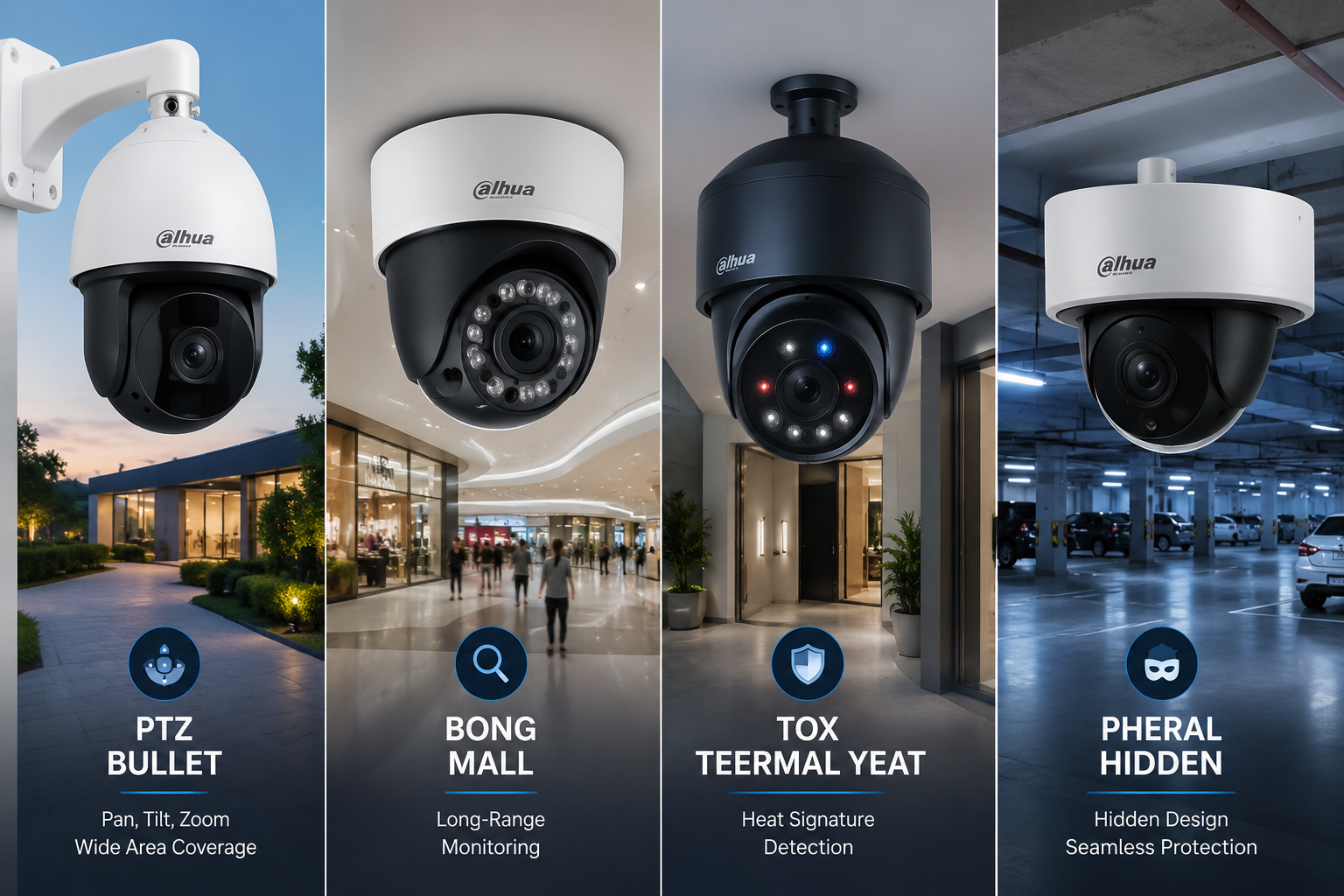
Dahua CCTV Camera Types: Which One Is Right for You?
"Which camera do I actually need?" is one of the first questions almost every buyer asks, and it's a fair one — Dahua's range spans several shapes, connection types and specialties. This guide breaks down the main Dahua CCTV camera types in plain language, so you can match the right one to your property rather than guessing.
Quick Answer
For most homes and small businesses, dome or bullet Dahua security cameras cover the basics well. Larger or open areas often benefit from a PTZ camera, low-light priorities call for a dedicated night vision model, and the choice between IP and HDCVI usually comes down to your cabling and whether you expect to expand the system later.
Table of Contents
Walk into a security store or browse a distributor's catalogue and you'll see camera names like "dome," "bullet," "PTZ," "IP" and "HDCVI" thrown around as if everyone already knows what they mean. In reality, each type solves a slightly different problem, and picking the wrong one usually means paying for features you don't need or missing coverage you do.
1. Dome Cameras
Dome cameras sit inside a rounded, low-profile housing that makes it harder to tell exactly which direction the lens is pointing. This makes them a common choice for indoor spaces such as shops, offices, reception areas and hallways, where a discreet, tamper-resistant design is preferred over an obvious camera shape.
Best for: indoor spaces, retail counters, ceilings and areas where you want coverage without drawing attention to the exact camera angle.
2. Bullet Cameras
Bullet cameras are the long, cylindrical shape most people picture when they think "CCTV camera." Because the direction is visible at a glance, they can work as a visible deterrent in addition to recording footage, which is one reason they're popular for entrances, gates, driveways and building perimeters.
Best for: outdoor entrances, gates, perimeters and anywhere a visible camera is part of the deterrent effect you want.
3. PTZ Cameras
PTZ cameras (pan-tilt-zoom) can be moved and zoomed either manually or automatically, letting a single camera actively cover a much larger area than a fixed one. They're a natural fit for warehouse yards, large parking areas, and open commercial or industrial sites where flexible, wide-area monitoring matters more than a single static frame.
Best for: large open areas, warehouse yards, parking lots and sites requiring active, flexible monitoring.
Tell us about your space
Share a few details about your property and we'll recommend the right camera mix for your coverage needs.
4. IP Cameras vs HDCVI Cameras
This is less about the camera's shape and more about how it connects to your recording system. IP cameras send video over a network cable, generally support higher resolutions, and scale well if you expect to expand your system later. HDCVI cameras use coaxial cable, which can be a practical, cost-effective choice for simpler setups or properties where coaxial cabling is already in place.
For a deeper side-by-side comparison, see our guide on IP cameras vs analog cameras in the UAE .
Best for: IP for larger, higher-resolution or expanding systems; HDCVI for simpler installs or existing coaxial infrastructure.
5. Night Vision Cameras
Many Dahua cameras include some level of night vision, but the actual range and clarity in the dark varies considerably between models. If nighttime coverage is a priority — for a driveway, a warehouse perimeter, or an unlit garden — it's worth comparing dedicated night vision cameras rather than assuming any standard model will perform equally well after dark.
Our best CCTV cameras for night vision in UAE guide compares specific options if this is your priority.
Best for: poorly lit driveways, perimeters, warehouse yards and any area where most activity happens after dark.
6. Wireless CCTV Cameras
Wireless CCTV cameras reduce or remove the need for running cable to every camera position, which can be useful where cabling is impractical, such as a detached structure or a rental property. Reliable performance depends on network signal strength, so wired options are still generally preferred for critical coverage areas.
Best for: properties where cabling is difficult, temporary setups, or secondary areas that don't need the most mission-critical reliability.
7. Quick Comparison Table
| Camera Type | Typical Use | Key Consideration |
|---|---|---|
| Dome | Indoor spaces, discreet monitoring | Direction less visible from outside |
| Bullet | Entrances, gates, perimeters | Visible deterrent effect |
| PTZ | Large open areas, yards | Active, movable coverage |
| IP | Larger or expanding systems | Network cabling, higher resolution |
| HDCVI | Simpler installs | Coaxial cabling, lower complexity |
| Wireless | Hard-to-cable areas | Depends on network signal strength |
8. How to Decide by Scenario
- Villa entrance or front door: bullet camera with night vision
- Retail counter or store interior: dome camera
- Warehouse yard or large parking area: PTZ camera
- Expanding office network: IP camera system
- Simple single-site upgrade with existing coax: HDCVI camera
- Detached shed or hard-to-cable spot: wireless CCTV
For a broader walkthrough of matching cameras to an entire property, our complete guide to Dahua CCTV cameras in UAE goes into more depth.
9. Can You Mix Camera Types?
Yes — most real installations combine more than one camera type. A typical villa, for example, might use bullet cameras with night vision at the entrance and driveway, and dome cameras indoors. The main thing to confirm is that your NVR system supports the mix of camera formats you're planning to use.
Frequently Asked Questions
What is the difference between a dome camera and a bullet camera?
A dome camera has a rounded housing that makes the viewing direction harder to identify, often used indoors. A bullet camera clearly shows its direction, which can act as a visible deterrent, and is commonly used outdoors.
Should I choose an IP camera or an HDCVI camera?
IP cameras generally offer higher resolution and more flexibility for larger or expanding systems. HDCVI cameras can be practical for simpler installations or existing coaxial cabling.
When should I use a PTZ camera instead of a fixed camera?
PTZ cameras suit large open areas needing active pan, tilt or zoom coverage, such as a parking lot or warehouse yard. For smaller fixed areas, a dome or bullet camera is usually simpler.
Do I need a dedicated night vision camera, or do all Dahua cameras see in the dark?
Many Dahua cameras include some night vision, but range and clarity vary by model. If nighttime coverage is a priority, compare models rated specifically for stronger performance.
Is a wireless CCTV camera as reliable as a wired one?
Wireless cameras can be reliable for many situations, but performance depends on network signal strength. Wired cameras generally offer a more consistent connection for critical areas.
Can I mix different camera types in the same CCTV system?
Yes, many systems combine different camera types depending on each area's requirements, as long as the recording equipment supports the mix.
Conclusion
There's no single "best" Dahua CCTV camera type — only the type that best fits the specific area you're covering. Match dome, bullet, PTZ, IP, HDCVI, wireless and night vision options to what each part of your property actually needs, and most systems end up using a sensible mix rather than one camera type throughout.
If you'd like help matching camera types to your property, contact our team , or read our guide on choosing the right CCTV supplier once you know which cameras you need.